

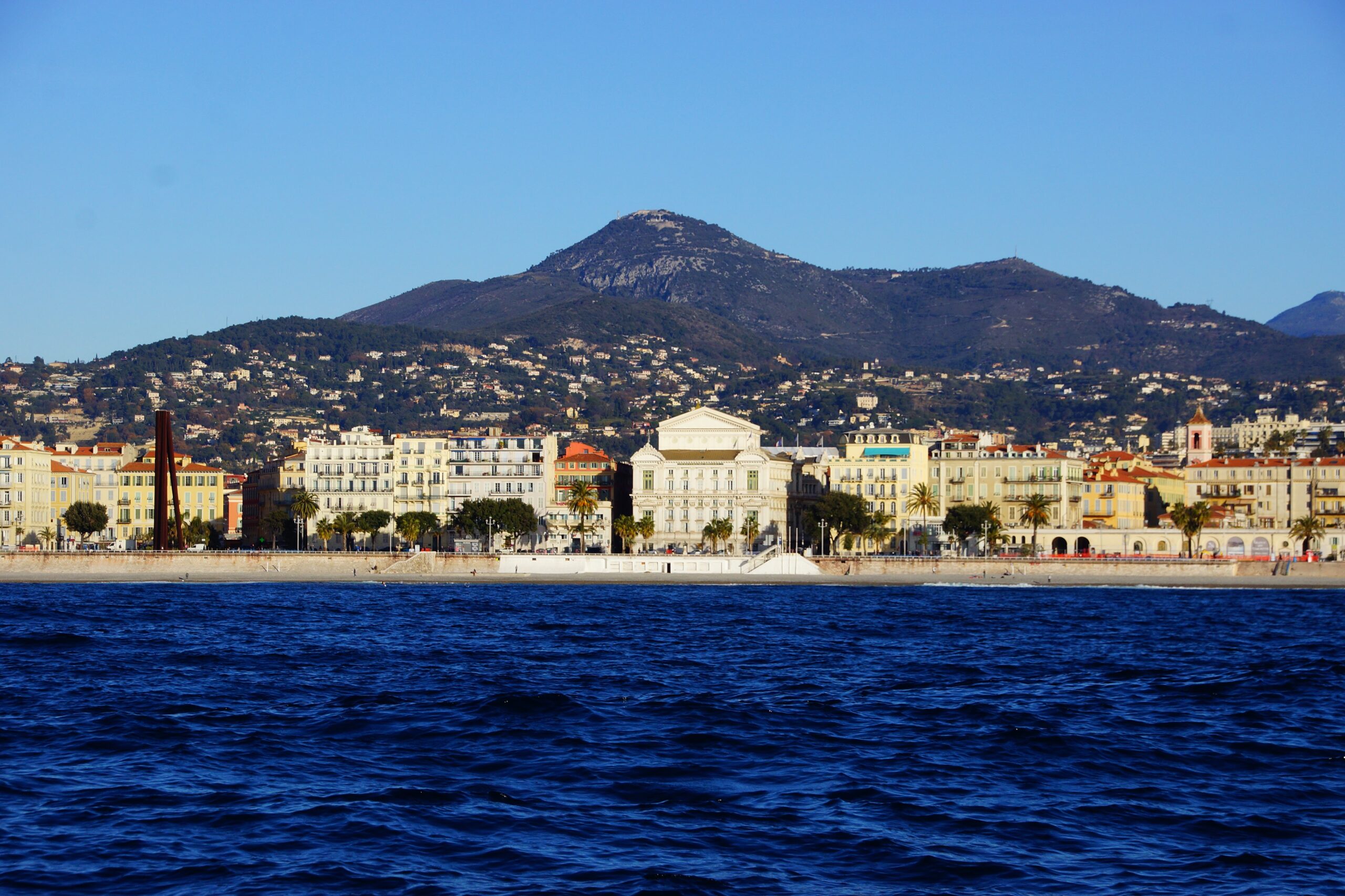
Nice rewards one full day more than almost any other city on the Mediterranean. It has a proper old town, two world-class museums, the best food market on the Riviera, a beach, and a hilltop with the finest view in the region. The trick is knowing the order to do things in, and knowing which parts to skip.
Start at the Cours Saleya market before 9am. This is where Nice eats, the flower sellers, the produce vendors, the fishmongers, the olive merchants with their forty varieties in ceramic bowls. The market runs Tuesday through Sunday from early morning until around 1pm, and the flower market section that gives the square its name is one of the most photographed sights in the south of France.
Eat breakfast here. The socca stalls on the western edge of the market sell the thin chickpea crepe that is Nice’s street food. Pissaladière, onion tart with anchovies and olives on a bread base, is the other one. Both need to be eaten hot, standing up, at the stall.
The Vieux-Nice behind the Cours Saleya is the original medieval city, built in the Genoese style with narrow lanes and tall ochre buildings that block the midday sun. The streets run in a grid that was laid down in the 13th century. The Baroque churches are worth going into, the Cathédrale Sainte-Réparate on the main square, the Chapelle de la Miséricorde on the Cours Saleya, but the main pleasure of Vieux-Nice is simply walking through it.
At the eastern end of the old town, take the lift (free) or the stairs to the Colline du Château. There is no castle, Louis XIV demolished it in 1706 after the War of Spanish Succession, but the hill has not been built on since, which means the 360-degree view is unobstructed. The sweep of the Baie des Anges to the west, the port to the east, the rooflines of the old town below, the Alps as a backdrop to the north on a clear day. This is the view that brought the British aristocracy here in the 18th century and it has not changed.
Nice has two museums that justify a visit on their own and are almost never crowded.
The Musée Matisse is in the Cimiez neighbourhood, a 15-minute drive north of the centre. The museum is inside a 17th-century Genoese villa surrounded by an olive grove and a Roman arena. Matisse moved to Nice in 1917 at the age of 47 and stayed until he died here in 1954. The collection includes works from his entire career, the early dark canvases, the Fauvist period, the Nice period with its Orientalist interiors, the late paper cutouts. The building and the garden are beautiful independent of the art.
Twenty minutes away, in a building designed specifically to house it, the Musée National Marc Chagall holds the largest public collection of Chagall’s work in the world. The 17 large-format paintings of the Biblical Message that form the core of the collection were painted specifically for this building, which Chagall supervised himself. The stained-glass windows in the concert hall are among his best works in any medium.
If you only have time for one: go to Chagall in the morning when the light through the windows is best. Save Matisse for late afternoon.
Lunch in Nice means Nicoise cooking, which is distinct from both French and Italian cuisine despite owing something to both. The salade Niçoise with fresh tuna (not tinned), green beans, tomatoes, and hard-boiled eggs. Pan bagnat, the sandwich version of the same salad, pressed and wrapped. Daube Niçoise, a beef stew braised in red wine with olives and orange peel. Ravioli de daube, filled with the leftover braised beef.
The best restaurants for Niçoise cooking are in the old town and around the Cours Saleya. Avoid anything directly on the Promenade des Anglais, the restaurants facing the beach charge for the view and deliver average food. The good cooking is in the lanes.
Walk the Promenade des Anglais westward after lunch. The 7-kilometre boulevard was built by the British community in the early 19th century as a walking path along the coast, hence the name, and expanded over the following decades as the winter season grew. The Hotel Negresco at the western end of the main section was built in 1913 and its pink dome is still the most recognisable structure on the waterfront. Step inside for the lobby: the rotunda with its 1920s chandelier and the collection of 20th-century artworks is worth five minutes.
A short detour north of the Promenade brings you to the Cathédrale Orthodoxe Russe Saint-Nicolas, the largest Russian Orthodox church outside Russia, built between 1903 and 1912 for the Russian aristocracy who wintered in Nice. The six onion domes are visible from a distance. The interior is covered in icons and the scale of the building is impressive for a city that was not, at the time of construction, a large one.
Come back to the Cours Saleya in the evening. The market stalls are gone and the restaurants are open. The square fills with people from around 7pm and dinner on a terrace here, with the old town buildings on three sides and the warm evening air that the Riviera does better than almost anywhere else in Europe, is a good way to end a day in Nice.
Nice works as a base for the entire Riviera. Monaco is 40 minutes east by car. Cannes is 45 minutes west. Eze, Villefranche, Saint-Paul-de-Vence, and the inland villages are all within 30 minutes. If you are staying in Nice for two or three days and want to explore the wider coast and hills, a private guide based here is the most efficient way to do it.
For the full picture on what a private tour of Nice covers, read our dedicated Nice private tour page. Or get in touch with your dates and we will design the day.